Author Image

Hi, I am Markus Gögele (AdronTech)

M.Sc. Markus Gögele

Satellite Software Engineer at OroraTech GmbH

I am a passionate engineer who enjoys working at the intersection of software, electronics, and mechanics. I publish and share my work online under the alias AdronTech. I studied computer science with a focus on robotics and enjoy solving complex problems in embedded systems. Space technology is one of my biggest interests because it combines demanding constraints with innovative engineering. In my free time, I build small projects and continuously learn new skills.

Projects

WARR Exploration
IT and Project Co-Lead February 2017 - March 2022

Building Rovers for Space Exploration

Experiences

1
OroraTech GmbH

May 2024 - Present

Munich, Germany

Intelligence-as-a-service company delivering thermal intelligence with Earth observation satellites to support wildfire detection and monitoring.

Satellite Software Engineer

May 2024 - Present

Responsibilities:
  • Develop embedded software for satellite and payload subsystems
  • Build and execute hardware-in-the-loop and integration test campaigns
  • Improve software reliability through verification, debugging, and mission-focused tooling

TNG Technology Consulting GmbH

April 2023 - April 2024

Unterföhring, Germany

Values-based consulting partnership focused on high-end information technology. TNG supports clients with state-of-the-art tools and innovative ideas to solve strategic and operational IT challenges.

Software Consultant

April 2023 - April 2024

Responsibilities:
  • Delivered technology consulting for enterprise software projects
  • Implemented frontend features and architecture in Angular
  • Developed backend services and APIs using Java and Kotlin
  • Collaborated with cross-functional teams to deliver production-ready solutions
2

3
Advantest Europe GmbH

May 2022 - Jan 2023

Munich, Germany

is a Japanese leading manufacturer of automatic test equipment (ATE) for the semiconductor industry. (Wikipedia)

Research and Development Engineer

May 2022 - Jan 2023

Responsibilities:
  • Write C++ drivers to interface with the tester hardware
  • Maintain automatic regression tests for the drivers
  • Develop tooling to improve development workflow

Garching, Germany

Project Co-Lead

August 2019 - July 2021

Responsibilities:
  • Plan project timeline
  • Coach new members
  • Manage 30-35 people
Software Team Lead

February 2019 - October 2020

Responsibilities:
  • Organize a team of 6-9 software developers
  • Guide new developers
IT Admin

August 2019 - October 2021

Responsibilities:
  • Supervise IT infrastructure
  • Orchestrate Email, File and Permission Server
4

5
German Aerospace Center (DLR)

October 2021 - March 2022

Oberpfaffenhofen, Germany

(German: Deutsches Zentrum für Luft- und Raumfahrt e.V., literally German Center for Air- and Space-flight), is the national center for aerospace, energy and transportation research of Germany. (Wikipedia)

Master Thesis

October 2021 - March 2022

Responsibilities:
  • Write final master thesis on the topic of autonomous uprighting of the MMX Rover.
  • Develop algorithms to make the uprighting process more reliable.
  • Design test scenarios and evaluate data in order to compare the algorithms.

Technical University of Munich (TUM)

September 2017 - September 2021

Garching, Germany

Responsibilities Tutor positions:

  • Give tutoring lessons each week
  • Grade homework of students
  • Grade final exam of students

Tutor: Basics of Computer Networks and Distributed Systems

April 2021 - September 2021

Tutor: Introduction to Computer Architecture

October 2020 - March 2021

Tutor: Basics of Computer Networks and Distributed Systems

April 2020 - September 2020

Tutor: Basics of Operating Systems and System Software

October 2019 - March 2020

Tutor: Basics of Computer Networks and Distributed Systems

April 2019 - September 2019

Tutor: Practical on Space-Electronics

October 2018 - March 2019

Research Assistant: Chair for Computer Vision and Artificial Intelligence

April 2018 - September 2018

Responsibilities:
  • Develop stereo camera test bench with inertial measurement unit (IMU)
  • Develop algorithm for automatic exposure calibration for stereo camera setup
Tutor: Introduction to Computer Science

October 2017 - March 2018

Tutor: Pre-Course Mathematics

September 2017 - September 2017

6

Education

M.Sc. in Robotics, Cognition, Intelligence
GPA: 1.6 out of 5
B.Sc. in Informatics: Games Engineering
GPA: 1.5 out of 5
High School
GPA: 95 out of 100
Taken Courses:
  • Electronics (Theory + Lab)
  • Automation (Theory + Lab)
  • Technology and design of electrical systems (Theory + Lab)
Mittelschule „Meran III“ in Obermais, Meran
2008-2011
Middle School
Grundschule „Hermann von Gilm“ in Obermais, Meran
2003-2008
Elementary School

Recent Posts

Hero Image
Master Thesis - Algorithm for Landing and Uprighting the MMX Rover with Gyroscopes

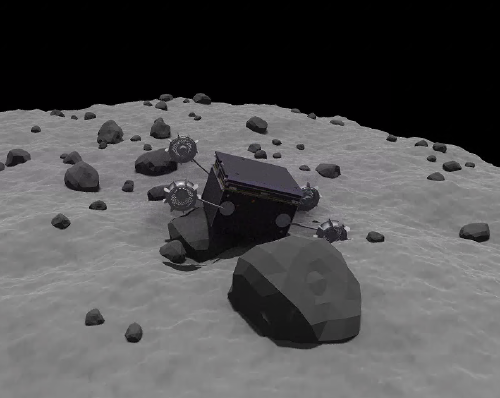
Abstract The Martian Moons eXploration (MMX) mission is planned by the Japanese space agency JAXA and will travel to Mars and its moons Phobos and Deimos. The main objective of the spacecraft is to collect a sample from Phobos. As a part of this Mission a small rover will be used to de-risk the main probe by letting it explore Phobos prior to touchdown. This rover is developed by CNES and the DLR and will be released from the spacecraft approximately 50m above ground where it will then fall onto Phobos. Af- ter some bounces on the surface the rover will autonomously unfold itself, deploy solar panels, and start recharging its batteries. The problem arises from the fact that after the fall and the bounces, the folded rover could be in any orientation and therefore it is not guaranteed that the rover is able to stand up and deploy its solar panels. The current implementation to tackle this problem is to just follow a pre-defined sequence of steps blindly. As this is a very critical single point of failure of this whole sub-mission it is desirable to increase the success rate of the deployment. It is very important to get the unfolding right the first time, as if the rover tries to unfold its solar panels without being in an upright position, the mechanism could get stuck and therefore the mission would fail. Once the solar panel deployment is done, the leg movement is restricted very drastically from a free rotation to operate within a specific angle range. This fact limits further recovery attempts and therefore it is unlikely to succeed the rover mission. From early prototypes it is shown that with the help of additional sensory feedback the success rate can be increased. The hardware for the mission is already finalized and therefore only the sensor suite present at the current time can be used to supplement the uprighting process. The onboard two axis MEMS gyroscopes are the best option to be used for this purpose. The hypothesis of this thesis is, that with the help of the built-in two-axis MEMS gyroscopes as feedback, a better result can be achieved. As the current implementation does nothing else than doing a blind guess and hoping for the best it should yield better results when some sort of informed guess is taken, and different conditions are checked to ensure the rover does not fall over. To do this, different approaches to incorporate gyroscopic sensors in this uprighting process are collected and implemented. Finally, all implementations are evaluated and compared to the cur- rent implementation to see if they are more successful. As access to real hardware is not feasible and the environmental conditions on Phobos with its low gravity are very special, it is not possible to do those experiments on real hardware and instead it is necessary to simulate everything. The whole system, including the sensors, need to be simulated in an effort to being able to create an ensemble of simulation runs, which is necessary to infer statistically relevant information and draw a conclusion on the suc- cess of the different methods. As this also includes the sensor, it is required to create a representative model of the sensor that is comparable to the real world counterpart. This model should model all necessary noise sources and uncertainties, but at the same time it should not over complicate the already extensive simulation to keep the simulation times low. In the end there will be a big comparison between all those approaches and the current implementation to see if the hypothesis is correct and where the strengths and weaknesses of the different methods are.

Hero Image
Bachelor Thesis - Rover Simulation in the Unreal Engine 4

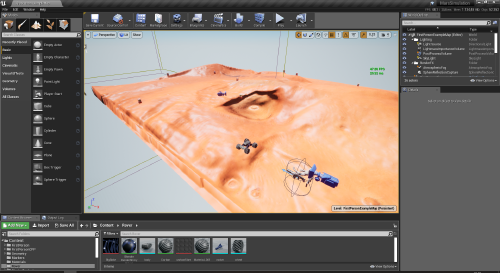
Abstract The subject of this bachelor’s thesis is the development of a framework for simulating robots and rovers in the Unreal Engine 4 (UE4). The simulation will connect to the robotic framework Robot Operating System (ROS) and provides photo-realistic images for computer vision applications. The well-established hardware abstraction layer interface called ros_control was used to support actuator control in the simulation. To extract sensory information from the photo-realistic virtual environment the rosbridge package was used. The newly proposed framework is a proof of concept for a game-engine-based simu- lator with the Robot Operating System (ROS) to perform computer vision experiments without requiring specialized hardware. It is also possible to use this framework to gather a dataset to train neural networks on or to evaluate existing machine learning techniques. This framework will be evaluated on the example of the European Rover Challenge (ERC). The student team from the Scientific Workgroup for Rocketry and Spaceflight (WARR) already created a simulation, which will be used as reference. The results of this bachelor’s thesis show that the framework works as intended for controlling simple actuators and joints; however, the current physics simulation of Unreal Engine 4 (UE4) does not provide enough stability to simulate the proposed complex scenario without major artifacts. Moreover, the camera plugin used in this thesis influences the physics simulation negatively when parameters are changed to achieve real-time high-definition support. The framework does, however, provide a real alternative to already in-use state-of-the- art solutions, as it enables an easy-to-manipulate robotic simulator with a powerful graphics engine for photo-realistic simulations.